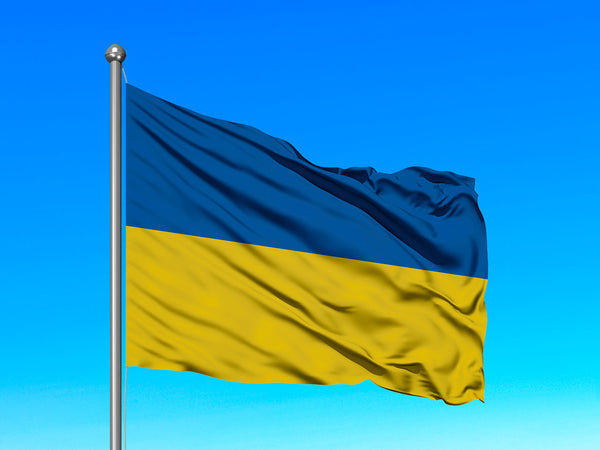


High-quality flag of Ukraine. Made in Latvia.
The flag is designed for use in harsh marine winds, made from specially durable fabric.
Material: Ecoflag®, 100% polyester, 165 g/m²
Made in Latvia. For prices of flags with your custom size, please inquire at veikals@karoguveikals.lv
The flag is designed for outdoor use.
Material: Ecoflag®, 100% polyester, 115 g/m²
Technology: Sublimation (CMYK colors) high resolution with thermal color fixation.
Finishing: Sewn edges with karabiners or a sleeve along the shorter edge.
The flag of Ukraine (Ukrainian: державний прапор України) is one of the official national symbols of Ukraine . It is rectangular, with an aspect ratio of 2:3. It consists of two equally wide horizontal stripes – blue and yellow – symbolizing clear blue skies over a golden wheat field.
Since 2004, Flag Day has been celebrated on August 23rd.
As a national flag, the blue and yellow flag has been used since 1848. It was first approved as the official national flag in 1918 during the Ukrainian People's Republic . After its incorporation into the USSR, Ukraine did not have an official national flag until 1949, when the flag of the Ukrainian SSR was adopted. The current flag was adopted after regaining independence.
Meaning of the colors of the Ukrainian flag stripes
Historians and scholars have not reached a consensus on the meaning of each color on Ukraine's national symbol. There are religious, philosophical, and logical interpretations.
- wheat field
- dedication to the memory of Kievan Rus'
- faith in God
- symbol of the creator, higher spirituality;
- the element of fire.
The yellow color corresponds to the masculine Yang, containing creative power.
Meaning of the blue color:
- sky
- rivers and mountains
- God's power
- all earthly things, God-given freedom of choice
- the element of water
For the first time, the yellow and blue combination was officially approved in the coat of arms of Lviv. The image of a golden lion on a blue shield was given to the city by Prince Daniel of Galicia.
In 1917, after the revolution, Ukraine's first attempts to declare independence began. After the establishment of the Central Rada and the election of Mykhailo Hrushevsky as president, a flag with a yellow stripe appeared at the top. But with the rise of Pavlo Skoropadsky to power, the blue stripe moved to the top.
During World War I, Ukrainian military units fought under two-color flags. The symbol was used primarily during battles: near Kruty, in the war with Poland and the Bolsheviks. In the first half of the 20th century, the blue and yellow flag was still in use. In Western Ukraine, the national symbol was a canvas with a blue stripe at the top and a yellow stripe at the bottom.
In 1939, Carpathian Ukraine attempted to gain independence under yellow and blue symbols. During World War II, OUN rebels, led by Andriy Melnyk, carried a blue flag with a golden trident and sword.
After the end of World War II, the yellow and blue symbol was banned. A red banner was displayed in all republics of the USSR. In Ukraine, there were periodic attempts to declare that it "was not yet dead." However, activists who took to the streets with the blue and yellow flag were arrested and sentenced to long prison terms.
In 1976, at the Olympic Games in Montreal, Canada, during a handball match between Soviet and Romanian teams, a Ukrainian student entered the field and waved a two-color flag. During the game between the USSR and GDR teams, a Ukrainian again entered the field, dressed in an embroidered shirt and holding a banner.
Recent times